
Construction Contract Types for Utah Custom Homes
Building Trust: A Deep Dive into Contracts
Choosing the right contract type sets the foundation for a remarkable client-builder relationship. Explore how Bluerock’s contract type gives you the best possible outcome for your home build.

Contract Types
Have you ever heard a contractor horror story? The cause of most issues can be traced back to the contract method used by the contractor. The most common options are:
Fixed Price: Contractor builds for a guaranteed fixed price
Cost Plus: Contractor builds for the true cost, plus a percentage fee
Cost Plus Fixed Fee: Contractor builds for the true cost, plus a fixed fee
Choosing the right contract type sets the foundation for a remarkable client-builder relationship. Let’s explore how Bluerock’s Cost Plus Fixed Fee format aligns goals, minimizes project challenges, and keeps your project on track.
Construction Contract Types for Utah Custom Homes
How Fixed Price, Cost Plus, and Cost Plus Fixed Fee Compare
When building a custom home in Utah, the construction contract you choose shapes everything from budget accuracy to how smoothly changes are handled during the build.
The comparison table below outlines the key differences between the three most common construction contract types used by Utah custom home builders. This page provides context for that comparison and explains why Bluerock builds exclusively using a Cost Plus Fixed Fee contract.
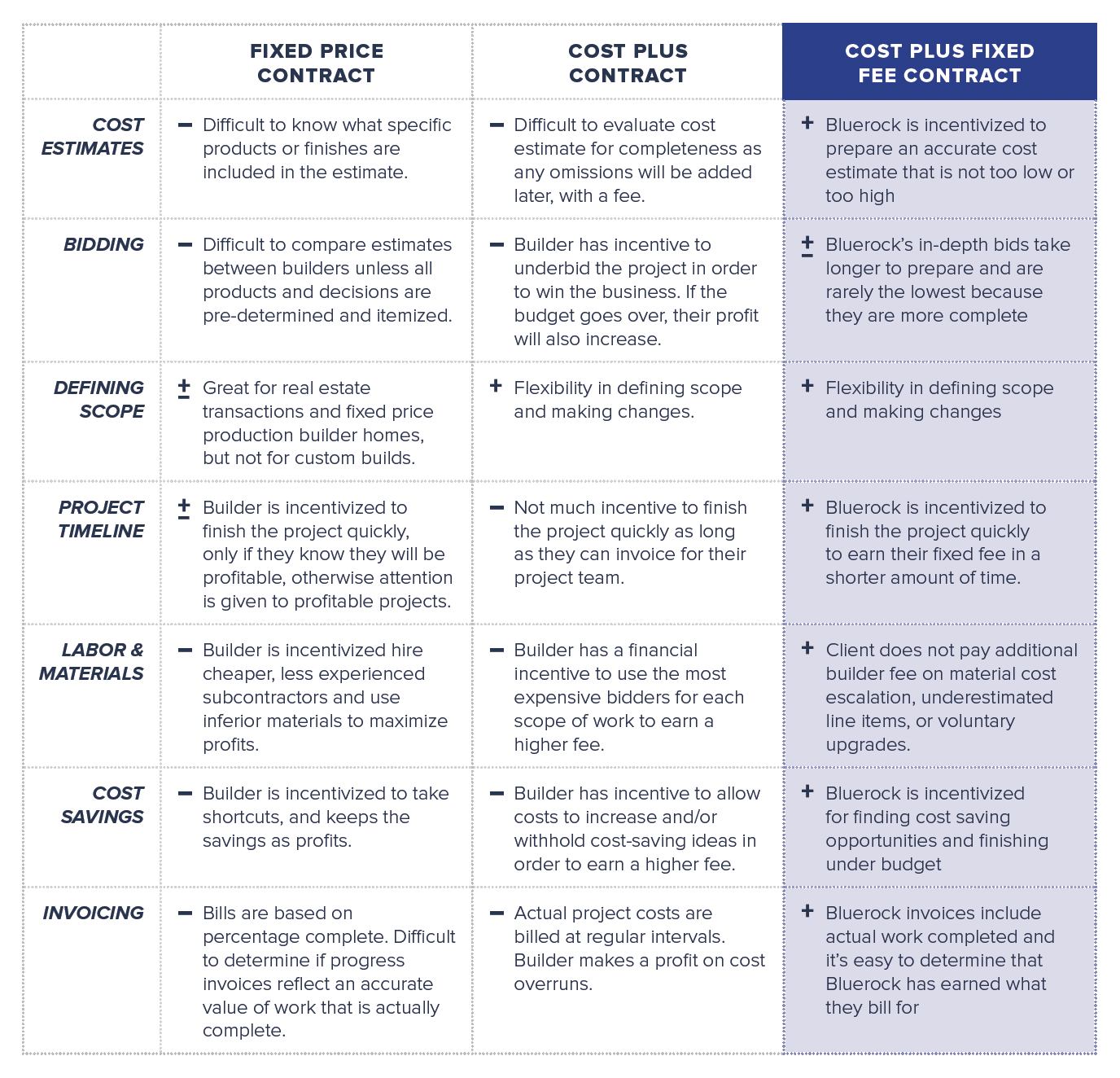
How to Read the Contract Comparison Table
Each contract type is evaluated across several critical categories that directly impact the homeowner experience, including:
Accuracy of initial estimates
Bidding and subcontractor pricing
How scope changes are handled
Timeline and schedule incentives
Transparency and invoicing
Risk allocation between owner and builder
Understanding these factors helps explain why the same project can feel very different depending on the contract structure—even when the final home looks similar on paper.
Fixed Price (Lump Sum) Contracts
In a fixed price contract, the builder commits to delivering the entire project for one set price, based on a fully defined scope at the start.
As shown in the comparison table, fixed price contracts prioritize price certainty, but often sacrifice flexibility and transparency. Because the builder assumes more risk, pricing typically includes contingency buffers, and changes later in the process are handled through formal change orders.
This structure can work well for projects with very limited variables, but it can become restrictive on custom homes where selections, site conditions, or design details evolve during construction.
Cost Plus Contracts
Cost plus contracts bill the homeowner for the actual cost of construction, plus a percentage fee for the builder.
The table highlights that cost plus contracts offer high transparency and flexibility, but less alignment of incentives. Because the builder’s fee increases as costs increase, homeowners must rely heavily on trust and active oversight to ensure efficiency.
This structure is commonly used for complex or evolving projects, but it can create uncertainty around final cost if not carefully managed.
Cost Plus Fixed Fee Contracts (Bluerock’s Standard)
A cost plus fixed fee contract combines the transparency of cost plus with clearer alignment between the homeowner and builder.
As reflected in the comparison table:
Actual construction costs are fully visible
The builder’s fee is agreed upon upfront
The builder’s compensation does not increase if costs rise
Scope changes are handled honestly and efficiently
This structure removes incentives to overspend, reduces conflict, and allows decisions to be made collaboratively as real conditions and pricing are revealed throughout the build.
Why Bluerock Uses Cost Plus Fixed Fee for Utah Custom Homes
Bluerock builds custom homes using Cost Plus Fixed Fee because it creates the most trust-based, transparent, and sustainable relationship between builder and client.
This contract structure:
Produces more accurate budgeting over the life of the project
Allows subcontractor bids to be evaluated honestly
Makes design and scope changes straightforward, not adversarial
Encourages schedule efficiency without sacrificing quality
Aligns builder incentives with the homeowner’s long-term goals
For high-end custom homes in Utah—where craftsmanship, site conditions, and selections matter—this approach consistently leads to better outcomes.
Choosing the Right Construction Contract
The comparison table below is designed to help you clearly see how each contract type performs across the areas that matter most during a custom home build.
If you value:
Transparency over hidden contingencies
Flexibility over rigid assumptions
Collaboration over conflict
A Cost Plus Fixed Fee contract is often the best fit.
Build With Clarity and Confidence
If you’re planning a custom home in Utah and want a construction process built on openness, accountability, and aligned incentives, we’re happy to walk you through the table and explain how Cost Plus Fixed Fee works in real-world projects.
